Friday, August 29, 2008

Moving? Consider donating some of your items

Monday marks September 1st, the start of many people's leases on their apartments. This weekend there is going to be ginormous amounts of people moving their stuff from one apartment to the next.

For those that don't have to move, it makes trying to drive around Boston difficult especially because those coming into Boston for the first time aren't familiar with the crazy road system here. The City of Boston is trying to help by increasing the amount of parking-enforcement officers and tow-trucks in areas which have a high-turnover in hopes to decrease the amount of problems throughout the city.

Moving day also means the city is going to be littered with garbage. Many people choose to leave anything they do not wish to move to their new place on the side of the street for the garbage people to pick up on trash day.

Yes, it sometimes is a great way to find end tables, in fact I have gotten two of my end tables from someone else's trash! However, most of people's unwanted furniture, toys, clothes and misc. items goes to our overcrowded landfills.

This is why I would like to remind people that you can take the extra time and donate many of the items you were going to leave on the side of the road. Some places even do curbside pick ups so you don't have to even leave your house. To find out what donatable items you have or what's available in your neighborhood go to earth911.org. It's my favorite site to find out where to either recycle or donate anything I no longer wish to keep.

My favorite place to donate is to Goodwill, in Davis Square. It's close by and is tax deductible. Here is a list of items they accept for donation:
  • Antiques, collectibles
  • Appliances (small)
  • Artwork
  • Bedspreads, blankets, curtains, tablecloths, decorative pillows
  • Bicycles
  • Books, records, tapes, CDs, DVDs
  • Clothing, belts, scarves, ties, pocketbooks
  • Cookware, dishes, pots and pans
  • Games and toys
  • House wares and decorative items
  • Jewelry
  • Sporting goods

I recently moved and I took TWO Full car loads over there of stuff to donate. It made my move easier and it felt great knowing that someone else will find use of the items I no longer wish to have/ fit into my new space. So I ask make three piles when moving, donatable, trash and moving and take the time to drop off any item that is donatable.

Related Stories: Don't Throw Out Your Old TV; Green Tips for the New Year Spring Cleaning, part deux

Photo courtesy of: http://uberfashion.co.uk/wp-content/uploads/2006/11/moving6pf.jpg

Thursday, August 28, 2008

Patio Gardens & City Growing

If we all grew just a few pots of veggies, herbs, or fruits like the folks above, we could make a big difference in the heat of the earth (because there would be soil instead of pavement) and in the amount of produce we have to buy from huge farms or from overseas.

During WWII, 40% of vegetables consumed in the US were produced in victory gardens. Imagine if that were true nowadays... of course here in the Northeast we have a little thing called "seasons," but even herbs can be grown on a sunny indoor windowsill in wintertime.

I know what I'll be doing this holiday weekend - planting a windowsill victory herb garden!

Related Posts: Finding Local Food Locally; CSAs Rock; Harvest Calendar for MA; Staycation in Boston; Fruit in the City; Jamming the Local Way

Tuesday, August 26, 2008

OYFP Turns 3, Globe Celebrates

OYFP celebrated its 3rd birthday at Globe Bar and Café on Thursday, August 21. Check out the Flickr account for pictures - you may be featured with a carrot stick in your mouth like Liz below.

The event, Local Action, Global Impact: OYFP Boston's 3rd Anniversary Party!, was a celebration of OYFP’s accomplishments over the past year.

Globe was a great place for this type of event. The manager of Globe, Julie Weeden, hooked us up! They provided us a private, balcony style, space that overlooked the bar area – free of charge! There was more than enough food for our guests and the friendly staff kept everyone happy.

When I reflect on OYFP’s accomplishments over the past few years I become increasing excited for the future. We're almost up in the big leagues and there ain't nothing wrong with that. We’re really starting to operate like a little organization. Tasks are becoming increasing delegated. We’ve had an intern. We’re in the process of applying for a large grant. We’re successfully planning, managing and executing multiple events in the same month. It’s an exciting time.

If you’re looking to get involved consider attending an upcoming event or shooting one of us an email.

On behalf of all the men, women, and children served by OYFP please accept our sincere thanks. We truly appreciate your partnership and generous support.

Monday, August 25, 2008

Find local food locally

Maybe you're a huge fan of locally produced food, or are traveling and want to eat locally at your destination, or heard the piece on NPR this morning about Walmart getting in on the local food scene, or on the other end of the spectrum, maybe you've never really tried committing yourself to local food and want to give it a go but aren't in the Boston area so don't find the links I've posted about local food useful. Phew, that was a run-on sentence if I ever wrote one.

Anyway. Never fear, the Eat Well Guide is here! The website makes it wicked easy for you to search for locally produced food. Simply put in a food type or zip code or city/state with the miles you're willing to travel, and wallah, local food options come up.

I had the best luck by using my zip code. Options including farmers markets, CSAs, stores, caterers, restaurants!, organizations, educational centers, and more came up. My favorite was the restaurants option for sure.

I love patronizing restaurants that are willing to take the extra time and risk to source their food locally. It typically tastes better, and I can feel better about the fossil fuels used to create my meal. I actually recently read an article in Edible Boston about the chefs at Craigie Street Bistro that discussed some of the issues with using locally produced food, mainly that you're much more at the mercy of Mother Nature.

If there are violent rains, the blueberries you were planning on using for dessert may not be available, so you have to get some early apples to make pie instead. If you order food from a normal distributor, if the blueberries in Maine that they were planning on using aren't available, they'll simply get some from New Jersey for you.

The simplicity of sourcing food nationally (and internationally!) is appealing for many (or rather, most) chefs, and right now, a must for some of the lower cost restaurants. However, even large low-cost chains like Walmart are seeing the wisdom of sourcing food locally due to the high cost of gas. However, Walmart considers any food produced in the same state it is sold as local... which may be true in places like Massachusetts or Delaware, but it certainly doesn't seem as though fruits grown in Southern California are "local" to San Francisco...

Semantics aside, the local food movement is growing (pun intended), and I for one am reveling in it. Of course, it's easy to love local food in New England when it's the summertime... when winter rolls around and my only local produce options are the peach preserves I made, the blueberries I froze, or potatoes, turnips, parsnips, and onions left over from the summer... I'll probably be singing a different tune.

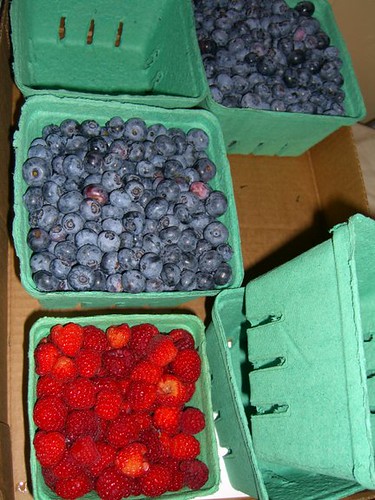
Until then, I'm going to enjoy my fresh corn, tomatoes, peaches, blueberries, kale, purple leafy vegetable that I don't know the name of, cucumbers, squash, basil, raspberries, green beans, peppers, onions, and eggplant, and I hope you'll go out of your way to enjoy local produce too.

The fruits of my labor - local peaches from Doe Orchards that I made into preserves!

Related Posts: CSAs Rock; Harvest Calendar for MA; Staycation in Boston; Fruit in the City; Jamming the Local Way
Related Events: Apples & Wine Sept 6

Fish out of water - My experience in Nicaragua

While cleaning out my computer's hard drive the other day, I came across this essay I wrote about my experience volunteering in Nicaragua with the Foundation for Sustainable Development. Unlike most "volunteer" programs, you are actually expected to do work, and since I had a bachelor's degree in psychology, I was a psychologist!

More difficult than the work, however, was fitting in. This essay discusses how I finally managed to do that.

- - - - - - - - - - - - - - - - - - - - - - - - - - - - - -

I am 5’9”, blond, and have blue eyes. I could not look more different than Nicaraguans. The average Nicaraguan woman is 5’2”, brunette, and somewhat rotund from the deep-fried foods that are consumed with abandon. The average Nicaraguan man can’t be taller than 5’5”!

During my four month stay in Nicaragua, I could not have become more painfully aware of these simple physical differences. However, I found that the barrier to “fitting in” wasn’t the presence of the physical differences, it was my attitude towards them. I had to accept that I was different and acknowledge that I would never be able to camouflage myself. Only then was I able to feel and act like I really belonged.

The first few days in Nicaragua were the hardest. I was literally a fish out of water, tossed into a hot, dry, and worn-out land when I was used to a cool, placid, and plentiful ocean. Every molecule in my body screamed to be back where I could breathe! My previous world, the one where all of my friends and family still lived, seemed incredibly and unbearably far away.

After my vision cleared and I learned how to breathe, it became evident exactly how different I appeared. The people of Nicaragua (men especially) did their part to remind me as well. “Hey muñeca.. chela… ¿que pasa?” [Trans.: Hey doll.. whitey.. what’s up?]

Everywhere I went, people pointed and commented. More than once, children poked or slapped any part of my body that they could reach, to see if the “doll” was real. With all of these constant reminders, how could I help but concentrate on how different I was than “those people”?

Spending time with Aimee, a tall, blond Peace Corps volunteer who had been living in Nicaragua for over a year, helped me both acknowledge and accept my physical differences. She had learned to laugh, saying “When the two of us living, breathing muñecas walk down the street together, they just don’t know what to make of it! We’re unbelievable!” At that point, I spoke Spanish like a native Nicaraguan. I was so brown I looked like a sorority girl who had fallen asleep on her tanning bed. But I was never going to look like I belonged.

Looking back on my trip, I realize that this was the turning point. After I accepted my physical differences, I made a few Nicaraguan friends. More than one told me, “You’re different than the other gringos. You speak, you listen, and you understand.” We talked about music, parents, favorite foods, best friends, and what exactly the mayor was thinking when he proposed dumping the city’s trash in the nearby volcanic crater.

I will never take for granted how much easier life is when you physically fit in. I will never forget that in order become part of a culture different than your own, you must acknowledge that you are a fish and everyone else a mammal.

This is not exclusionary, pessimistic, or close-minded.

Robert Reich, who at 4’9” is one of the shortest politicians out there, starts every speech with a joke about his height. By acknowledging his physical difference, he makes it possible for everyone to stop concentrating on his stature and start concentrating on what he has to say.

Once you get the elephant in the room out of the way, it is possible to start forging friendships, really learning what it’s like to live within the new culture, and creating an experience that you will never forget.

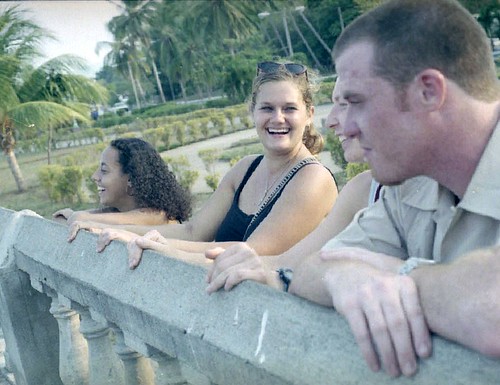
Nora, Aimee (the Peace Corps volunteer) and two of her friends at a park in Granada. The photo is a scanned in negative because back in 2003 I didn't have a digital camera.

Related Posts: International volunteering for teens; Food prices are rising; Chinese Earthquake - How to help; Global volunteering; Gap Year

Photos courtesy of Casey.

Friday, August 22, 2008

Recycling while Traveling

I try to be as green as possible but I have come to realize it is very difficult when you are traveling. For example, you can not bring a reusable water bottle when boarding a flight due to security enforcing the 3 oz liquid rule. I understand the reason for this, so I am fine with not bringing any big water bottles on board.

I however, like to stay hydrated, so like many people do, I buy a bottle of water after I have gone through security. Recently I was at Logan airport and I did not see any place to discard my recyclable bottle of water once it was finished. I was faced with a choice of bringing it on the plane and adding it to my cramped leg room and wait until I find a recyclable container, or throw it in the dreaded garbage. I chose to throw it away faced with the uncertainty of when I would be able to find a recyclable container.

Little did I know that other airports supports being green and have recycle containers next to all garbage bins. For example, Chicago's O'Hare airport has the container to the right next to EACH garbage can.

Seeing this little bin made me wonder why Mayor Menino, who continues to push Boston to become more green, doesn't push for Logan airport to become more green. This is an especially needed component, considering Logan airport is one of the 20 busiest airports in the U.S., with over 27 million passengers a year!

Also while traveling I noticed there were no recycle containers in the hotel suite I was in. Again there was no other alternative for me being in semi unfamiliar territory to know where I could recycle the paper & plastic containers I have accumulated while staying at the hotel.

This is unfortunate because I believe if there were more recycle receptacles in hotels and airports, this would reduce the amount of garbage going to landfills in the USA quite considerably.

This is my experience with traveling but I would love to hear other stories, especially those companies that have done more to become more green. Maybe I flew out of the one airport that doesn't (yet) have a program and perhaps stayed at the one hotel that doesn't particpate (yet).

Photo courtesy of: Moi

Related Posts: Green Tips for the New Year, Getting away from it all, "Staycation" in Boston